



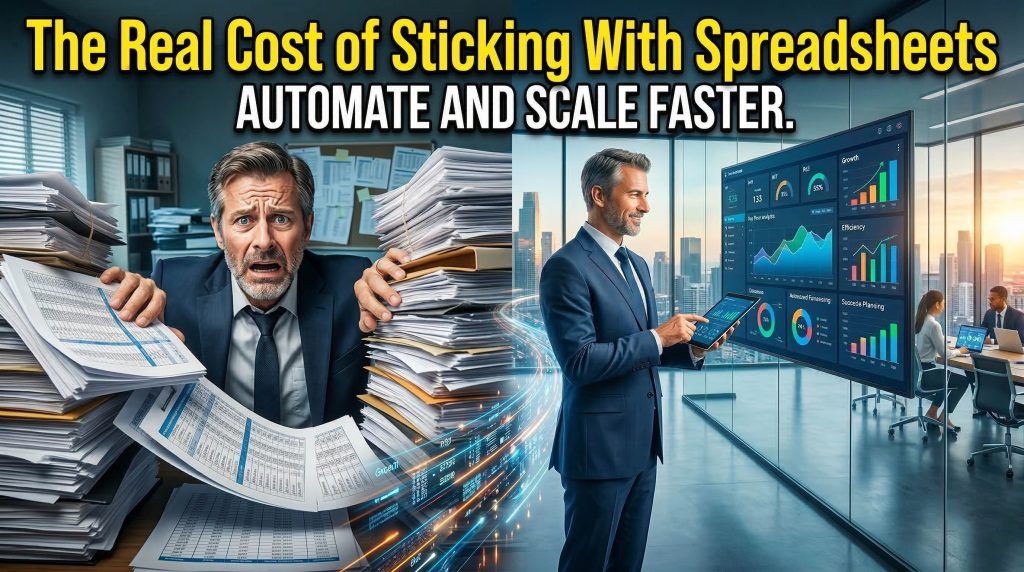
We’ve all been there. You have a big decision to make, and your first instinct is to open a blank Excel sheet. For years I’ve watched leaders in boardrooms across the globe rely on the humble spreadsheet to run multimillion-dollar operations.
It feels safe. It feels familiar. Best of all, it feels “free.”
But after decades of helping businesses bridge the gap between daily operations and long-term profitability, I’ve realized that “free” is often the most expensive price you can pay. While spreadsheets are brilliant for quick calculations, using them as the primary engine for your Finance, HR, or Supply Chain planning is a quiet growth-killer.
The Invisible Drain on Your Efficiency
The problem isn’t the software; it’s the manual nature of the process. When your planning lives in a workbook, you aren’t just managing data, you’re managing a house of cards.
- The “Engine Room” Trap: I often see founders and finance teams spending 80% of their time just “cleaning” data and 20% actually analysing it. If you are paying high-level executives to copy-paste cells and fix broken VLOOKUPs, you are haemorrhaging money.
- The Version Control Nightmare: Who has the “Final_v3_Updated.xlsx” file? When data is siloed in individual inboxes, you lose the “single source of truth.” Decisions get made based on outdated information, leading to missed targets and misaligned teams.
- The Risk of Human Error: Even the most diligent professional can miss a typo in a formula. In a complex financial model, a single misplaced decimal point can lead to a catastrophic forecast that isn’t discovered until it’s too late.
Identifying Your Tipping Point
How do you know when your spreadsheets have moved from “helpful tool” to “growth bottleneck”? In my experience, there is a specific tipping point where the manual process starts to cost more than the solution.
You’ve reached the tipping point if:
- You dread “What-If” scenarios. If a board member asks, “What happens to our margin if the exchange rate shifts by 5%?” and your team needs three days to re-work the sheets to give an answer, you’ve outgrown your system.
- Audit trails are non-existent. If you can’t tell who changed a budget figure or why, your risk profile is too high.
- The “Key Person” risk is peaking. If only one person in the company knows how the master spreadsheet works, your entire strategic planning is one “resignation letter” away from collapsing.
A Roadmap to Automation (Without the Chaos)
The biggest fear leaders have is that moving to an automated system will break the business during the transition. It doesn’t have to. Digital transformation is 20% technology and 80% people.
Here is how we move from manual to automated without the headache:
1. Audit the Current Mess Don’t automate a bad process. We start by looking at your current sheets to identify what is actually working and what is just “noise.”
2. Start with a Pilot Project You don’t need to overhaul the entire company on day one. We pick one high-impact area (usually Finance Planning (FP&A) or Sales Performance) and automate that first. This creates a “Proof of Value” that wins over the rest of the team.
3. Connect the Data Sources The goal is to move from manual entry to “Self-Updating” forecasts. By connecting your ERP, CRM, or HR systems directly to a planning platform, your data flows in real-time. No more copy-pasting.
4. Focus on the “People-First” Change Automation only works if your team trusts it. We focus on training and change management to ensure your people feel empowered by the new tools, rather than replaced by them.
Moving Beyond the Cell
Spreadsheets will always have a place on our desktops for quick notes and scratchpad math. But if you want to scale a sustainable, profitable business in 2026, you cannot afford to have your vision limited by the borders of a cell.
Automation gives you back the one thing spreadsheets take away: Time. Time to lead, time to strategize, and time to focus on the relationships that actually grow your business.
Is your team spending more time in the “engine room” than the “cockpit”? We can quickly audit your current processes and see where we can leverage technology to clear the path for your growth. Setup a quick call here